
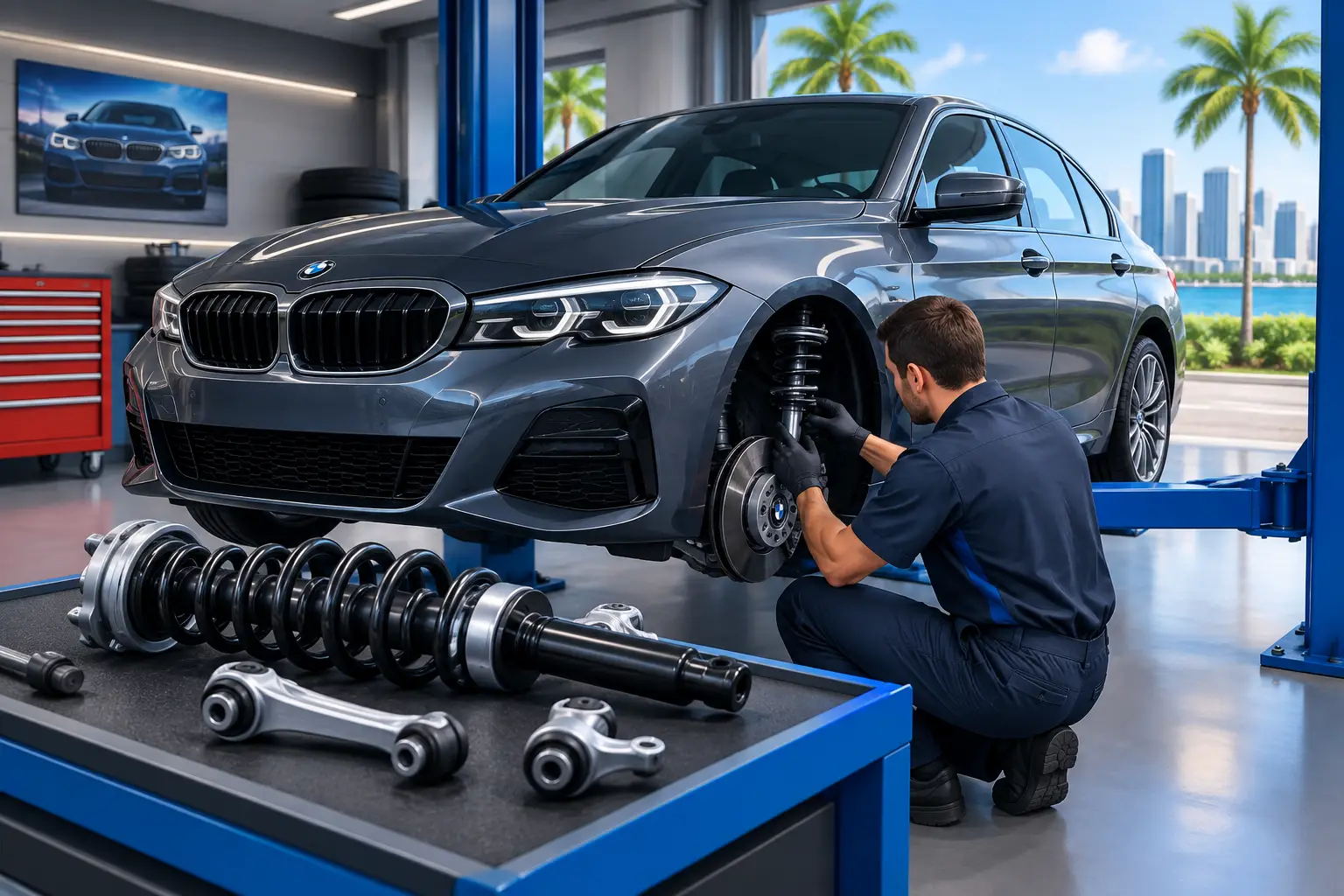
A BMW that feels unsettled over Tampa’s broken pavement, pulls during a highway lane change, or clunks when entering a parking garage is communicating a real mechanical concern. BMW suspension repair Tampa owners can rely on starts with identifying the exact source of that change, not replacing parts based on a guess. On a precision-built vehicle, a worn bushing, tired shock absorber, bent wheel, or alignment issue can create similar symptoms while requiring very different repairs.
Why BMW Suspension Problems Need Specialist Diagnosis
BMW suspension systems are designed to do more than soften bumps. They keep the tire contact patch planted, help the vehicle turn predictably, control body movement, and protect the confidence that makes a BMW feel different from an ordinary vehicle. Whether you drive a 3 Series sedan, X5 SUV, M model, or an electric BMW with added vehicle weight, the suspension must work as a complete system.
That is why a noise alone is not a diagnosis. A front-end clunk may come from a control arm bushing, ball joint, sway bar link, strut mount, spring, or even a loose underbody component. A vibration may point to wheel balance, tire damage, a bent wheel, worn suspension hardware, or a combination of issues. Replacing the first part that appears suspicious can leave the original concern unresolved and add unnecessary cost.
A proper inspection considers the vehicle’s mileage, service history, tire wear, ride height, alignment readings, road-test behavior, and the condition of connected steering and suspension components. This approach is particularly important on BMWs with electronically controlled dampers, adaptive suspension, rear air suspension, Integral Active Steering, or xDrive. The mechanical system and the vehicle’s electronics must be evaluated together.
Signs You May Need BMW Suspension Repair in Tampa
Some suspension wear develops gradually enough that owners adapt to it without realizing how much vehicle control has changed. Others appear suddenly after a pothole strike, curb impact, or contact with road debris. If your BMW exhibits any of the following concerns, it deserves a professional evaluation:
- A knocking, rattling, squeaking, or creaking noise over bumps or while turning
- Excessive bouncing after a dip in the road or a floating sensation at highway speed
- Uneven, feathered, or unusually rapid tire wear
- Steering that wanders, feels loose, pulls to one side, or does not return smoothly
- A nose-down stance under braking, excessive body roll, or a rear corner sitting low
- Warning messages related to chassis, suspension, or ride-height control
Not every symptom means a major repair. A minor noise could be a worn sway bar link; uneven tire wear could be caused by an alignment correction before expensive tires are replaced. At the same time, postponing a worn control arm or failed damper can accelerate tire wear, reduce braking stability, and place additional stress on related parts.
Tampa Roads Can Expose Existing Wear
Heat, heavy rain, expansion joints, potholes, construction zones, and abrupt pavement changes all challenge suspension components. Florida’s climate does not create the same salt-related corrosion seen in northern states, but rubber bushings, mounts, and hydraulic components still age. A low-profile tire and sport suspension can make an impact feel sharper and increase the chance of wheel or alignment damage.
After a significant pothole impact, do not assume the issue is limited to the tire. A tire can look normal while a wheel is slightly bent, an alignment angle has shifted, or a control arm has been damaged. Prompt inspection protects both the vehicle and the tires you depend on every day.
Common BMW Suspension Repairs
The right repair depends on the model, equipment, and confirmed condition of the components. BMW front suspensions often use multiple control arms to deliver accurate steering feel. When bushings or ball joints wear, drivers may notice instability under braking, vibration, pulling, or a dull clunk over uneven surfaces. Depending on the design and condition, replacing the complete control arm may provide a more durable result than attempting a partial repair.
Struts and shock absorbers control spring movement. When they weaken, the BMW may bounce, dive, or feel less composed through turns. Leaking dampers should be addressed, but visible leakage is not the only sign of failure. Internal wear can reduce damping performance without an obvious external leak.
Springs, strut mounts, sway bar links, sway bar bushings, wheel bearings, and rear suspension components can also affect ride quality and handling. On models equipped with air suspension, a sagging corner may result from an air spring leak, damaged air line, compressor issue, valve block concern, or a sensor-related fault. These systems require accurate testing before parts are selected.
Performance BMWs add another consideration. M cars and vehicles with factory sport packages often have firmer components, aggressive alignment specifications, and wider tires. An experienced technician must preserve the intended character of the vehicle rather than applying a generic repair approach that compromises handling or comfort.
Alignment Is Part of the Repair, Not an Afterthought
Wheel alignment is often necessary after suspension or steering work, but it should not be treated as a simple add-on. BMW alignment specifications are precise, and ride height can affect those measurements. If worn parts are aligned before they are repaired, the settings may not remain stable.
A correct process addresses worn or damaged components first, verifies tire condition and inflation, then performs a four-wheel alignment using proper equipment and model-specific specifications. For certain BMWs, steering-angle sensor calibration or other electronic procedures may also be needed. This is especially relevant when the vehicle has advanced driver-assistance features that rely on accurate chassis geometry.
There is also a practical trade-off between tire longevity and performance feel. Some BMW models have alignment settings that naturally produce more inner-edge tire wear, particularly when driven aggressively. A knowledgeable shop can explain what is normal for your vehicle, what has moved out of specification, and whether a different alignment preference is appropriate for how you drive.
OEM-Quality Parts and Correct Procedures Matter
Suspension repairs are not the place to select parts based only on the lowest initial price. Poor-quality components can introduce noise, wear prematurely, or change the way the vehicle tracks and responds. Quality OEM parts or OE-equivalent components chosen for the specific BMW application help preserve the engineering that owners expect.
Installation matters just as much. Many suspension bushings must be tightened at the correct loaded ride height, not while the suspension hangs freely. Fasteners may have specified torque values or be single-use hardware. Skipping those details can shorten component life and create avoidable noise or handling concerns.
Fox Motors Bimmer Specialists approaches BMW repair with this level of intention, pairing marque-specific diagnostic capability with quality parts, transparent estimates, and a three-year/36,000-mile warranty on most repairs. For owners balancing dealer-level technical expectations with independent-shop value, the goal is straightforward: repair the actual problem correctly and protect the vehicle for the miles ahead.
What to Expect From a Professional Suspension Inspection
A thorough suspension appointment should begin with your description of when the concern occurs. Does the noise happen only over bumps? Under braking? During low-speed turns? After rain? These details help narrow the diagnostic path before the vehicle is lifted.
The technician should then inspect the suspension, steering, tires, wheels, brakes, and underbody for play, leaks, impact damage, and abnormal wear. A road test may be necessary to confirm the concern under the conditions where it occurs. If alignment is involved, measured results should guide the recommendation rather than assumptions.
You deserve a clear explanation of what has failed, what is beginning to wear, and what can reasonably wait. Not every aged bushing requires immediate replacement, but safety-related looseness, damaged components, failed dampers, or tire wear concerns should not be deferred. A transparent estimate lets you make that decision with confidence.
Protect the Ride Before the Problem Spreads
Suspension concerns rarely improve with use. What begins as a faint clunk or slightly uneven tire wear can become a larger repair if related components, wheels, or tires are allowed to suffer. Scheduling an inspection early gives you more options, helps preserve the BMW’s handling, and keeps small changes from becoming expensive surprises.
If your BMW no longer feels as composed, quiet, or precise as it should, trust that impression. The right diagnosis can restore the confidence you felt the first time the vehicle settled into a corner or tracked cleanly down the road.