
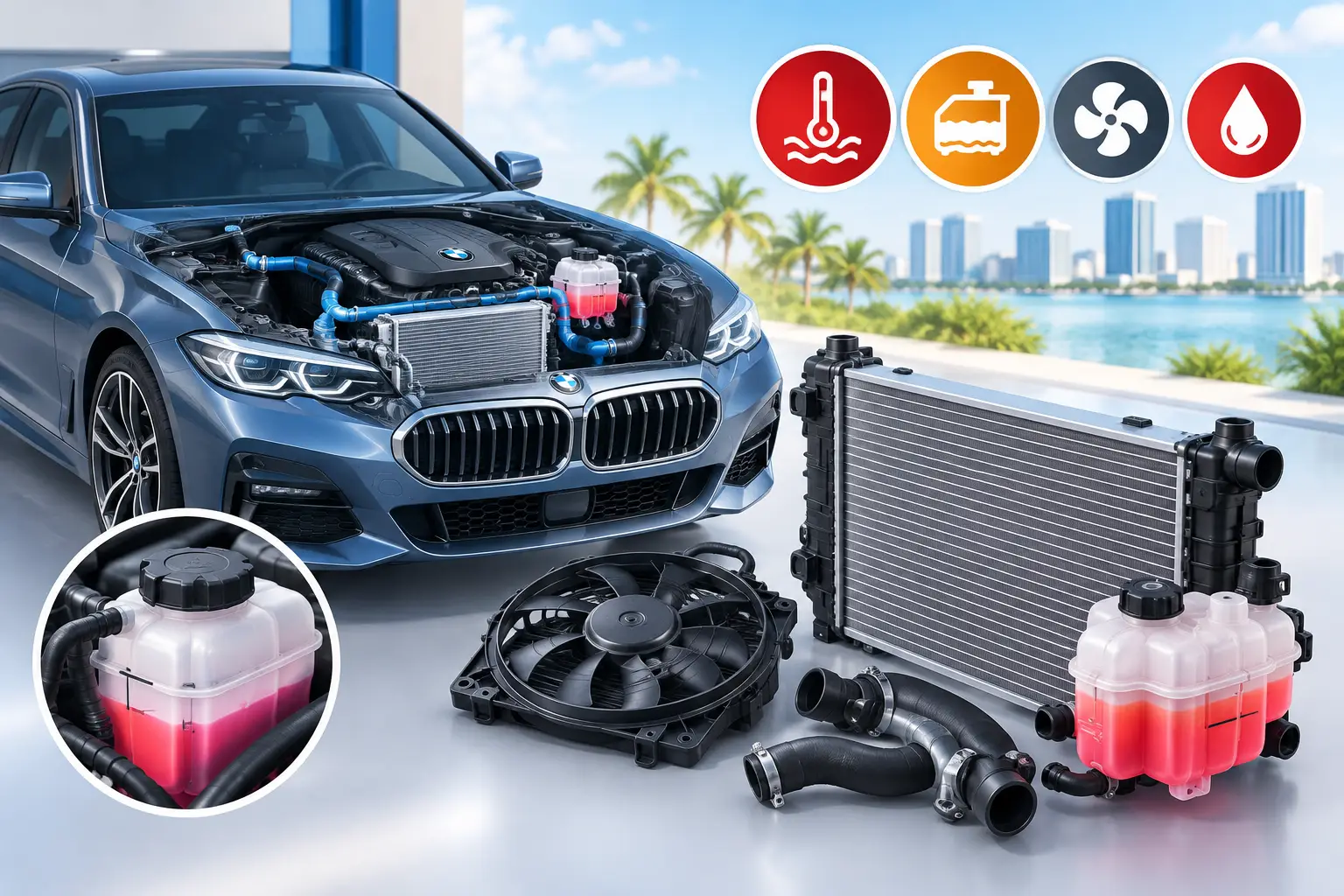
A BMW temperature warning is not a message to watch for a few more miles. It is a signal to reduce load, pull over safely, and arrange qualified BMW cooling system repair Tampa owners can trust. Modern BMW engines operate within carefully managed temperature ranges, and a small leak, weak pump, or failed thermostat can become an expensive engine repair when heat is allowed to build.
BMW cooling systems are engineered for efficiency, performance, and emissions control. That also means they are more complex than the systems found in many ordinary vehicles. Correct repair begins with accurate diagnosis, not simply adding coolant or replacing the first part that appears suspicious.
Why BMW Cooling Systems Need Specialist Attention
Many BMW models use electronically controlled water pumps, map-controlled thermostats, composite plastic components, pressurized expansion tanks, and multiple coolant circuits. Turbocharged, plug-in hybrid, and high-performance M models can add further complexity. The vehicle may manage engine temperature differently under highway cruising, hard acceleration, stop-and-go traffic, or electric-only operation.
A generic repair approach can miss the actual cause. For example, an expansion tank may crack because of age, but repeated cooling-system pressure can also point to a thermostat that is not regulating correctly, a pump that is losing efficiency, or combustion gases entering the cooling circuit. Replacing one visible leaking part without testing the entire system may get a vehicle moving again without restoring long-term reliability.
At Fox Motors Bimmer Specialists, cooling-system work is approached with the same precision as any other major BMW service. The goal is to identify the failure, verify related components, and recommend repairs that respect the vehicle’s engineering and the owner’s budget.
BMW Cooling System Repair Tampa: Signs You Should Not Ignore
Some cooling-system failures announce themselves clearly. Others start as an occasional smell, a low coolant message, or a heater that no longer performs consistently. Tampa’s heat and traffic can expose marginal components quickly, particularly during extended idling with the air conditioning running.
Low coolant warnings that return
A low coolant warning is not normally caused by coolant simply being used up. BMW cooling systems are closed systems, so a recurring warning usually indicates an external leak, an internal leak, or a level-sensor concern. Adding coolant may be appropriate as a temporary emergency measure, but it is not a repair.
Look for dried white, blue, or pinkish residue near the expansion tank, radiator connections, hoses, thermostat housing, or water pump. Depending on the BMW model and coolant used, residue color can vary. A technician should pressure-test the system rather than rely only on what is visible from above.
Temperature warnings or overheating
If the temperature gauge rises, the cooling fan becomes unusually loud, steam appears, or the iDrive display shows an engine-temperature warning, stop driving as soon as it is safe. Do not open the coolant cap while the engine is hot. Pressurized coolant can cause serious injury.
Continuing to drive an overheated BMW can damage cylinder heads, head gaskets, turbochargers, and internal engine components. The cost difference between an early cooling-system repair and an overheated-engine repair can be substantial.
Coolant odor, puddles, or a sweet smell
Coolant often has a distinct sweet odor. You may notice it after parking, when using the heater, or after a hot drive. A puddle beneath the front of the vehicle deserves inspection, but leaks do not always reach the ground. Underbody panels can hold fluid, and coolant can evaporate on hot engine components before a puddle forms.
Weak cabin heat or inconsistent climate control
The heater core relies on hot coolant moving through the system. If cabin heat becomes intermittent, especially at idle, the cause may be low coolant, trapped air, restricted flow, a failing water pump, or a climate-control issue. It depends on the model, but this symptom should be diagnosed before it develops into a more obvious overheating event.
Fan noise, reduced power, or stored fault codes
An electric cooling fan that runs loudly after a short drive may be responding to elevated temperatures or a sensor issue. Some BMWs also reduce engine power when temperatures rise, protecting the engine before severe damage occurs. That protective strategy is valuable, but it is not permission to continue driving.
Common BMW Cooling-System Failure Points
Age, mileage, driving habits, and model-specific design all matter. A BMW used for short trips may show different concerns than one driven regularly at highway speed. Still, several components deserve close attention during inspection.
The electric water pump is one of the most important. Unlike a belt-driven mechanical pump, an electric pump is commanded by the vehicle’s control modules. It may fail abruptly, lose output under demand, or store faults before a complete failure occurs. Proper diagnosis includes checking fault memory, command signals, operating data, and actual cooling performance.
Thermostats can fail open, closed, or in an incorrect regulated position. A thermostat stuck open may prevent the engine from reaching proper operating temperature, affecting efficiency and cabin heat. A thermostat that does not open when commanded can contribute to rapid overheating.
Expansion tanks, hose connections, radiator end tanks, and plastic flanges are also frequent sources of leaks as they age through repeated heat cycles. These parts may look acceptable until a pressure test reveals a crack or seep. On some BMW engines, oil-filter-housing seals, coolant pipes, auxiliary radiators, and turbocharger cooling lines also require careful inspection.
For plug-in hybrid BMW models, cooling-system service requires added awareness. High-voltage components and battery thermal-management circuits have specific service procedures. The right diagnostic equipment and trained handling are not optional when servicing those systems.
What Accurate Cooling-System Diagnosis Looks Like
Replacing parts based on internet symptoms is a gamble. A professional diagnosis should begin with a visual inspection and a discussion of exactly what the vehicle has done: warning messages, coolant loss, fan behavior, temperature conditions, and recent repairs.
Next, the technician may pressure-test the cooling system to locate external leaks, inspect the engine bay and undertrays for evidence of seepage, and scan BMW-specific modules for faults and live data. Monitoring commanded versus actual temperature, water-pump operation, thermostat behavior, and fan activation often reveals problems that a basic code reader cannot.
If no external leak is found, additional testing may be necessary. This can include checking for combustion gases in coolant, inspecting oil and coolant condition, and evaluating whether an internal component is allowing fluid to migrate where it should not. Not every overheating concern has the same cause, which is why a clear diagnosis protects both the vehicle and the repair budget.
After a repair, the system must be refilled with the correct approved coolant mixture and bled using the proper BMW procedure. Air trapped in the system can cause poor heater performance, warning messages, and overheating. On many models, the bleeding process uses an electronically controlled pump cycle rather than a simple old-fashioned bleed screw.
Repair Decisions: What Should Be Replaced Together?
There is no honest one-size-fits-all answer. If a single hose has been damaged by an outside impact and the surrounding parts are in excellent condition, a focused repair may be reasonable. If an older BMW has a failed water pump and several original plastic cooling components showing age, replacing related high-risk items during the same visit can reduce the chance of another breakdown soon after.
The right recommendation balances mileage, model history, visible condition, labor overlap, and how long you intend to keep the vehicle. A specialist shop should explain what is required for safe operation, what is preventive, and why each recommendation is being made. Transparent estimates matter because premium-car ownership should not mean vague advice or surprise charges.
OEM-quality parts are also worth discussing. Cooling components must tolerate heat, pressure, vibration, and repeated thermal cycles. The lowest-priced part can become the most expensive choice if it fails early or creates a second leak in a difficult-to-access area.
Protect Your BMW Before the Next Tampa Heat Cycle
Check for warning messages promptly, pay attention to unusual odors, and do not assume a topped-off reservoir has solved a coolant-loss issue. Keep records of previous cooling-system repairs, especially water-pump, thermostat, hose, and expansion-tank replacements. That history helps a BMW specialist make a more accurate recommendation.
If your BMW is showing a coolant warning, temperature concern, or unexplained leak, schedule an inspection before the problem chooses its own timing. A careful diagnosis and properly completed repair can preserve the quiet confidence, performance, and long-term value you expect every time you drive.