
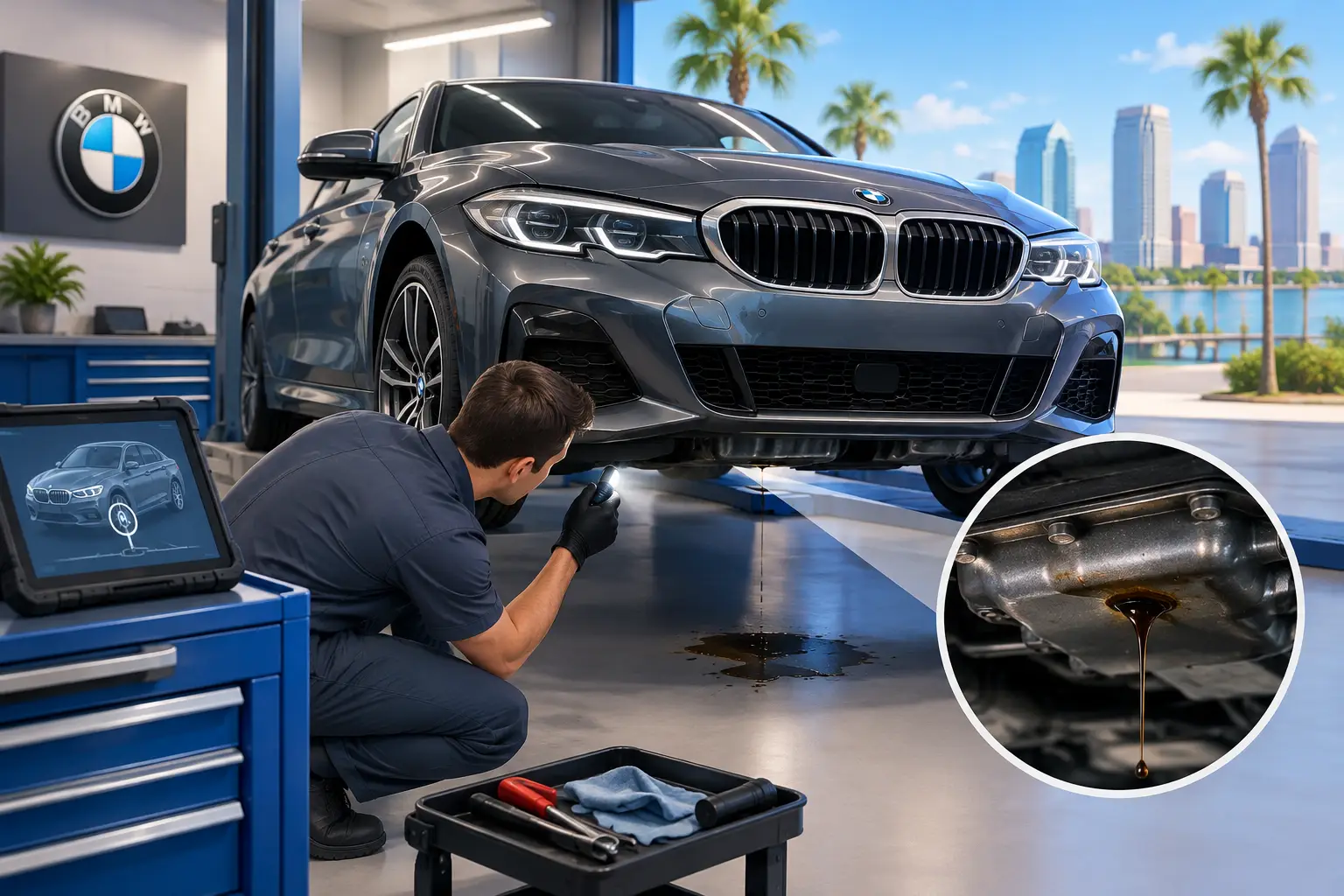
A few drops on the garage floor may look minor, but on a BMW, the visible oil is often only the final point in a longer path. Heat, airflow, underbody panels, and tight engine-bay packaging can move oil far from its source. Proper BMW oil leak diagnosis Tampa owners can rely on means finding where the leak begins, determining why the seal or component failed, and repairing it before oil reaches belts, cooling hoses, electrical connectors, or hot exhaust components.
Florida heat adds another layer of urgency. High underhood temperatures can harden rubber gaskets, accelerate plastic-component wear, and turn a slow seep into a repair that deserves prompt attention. The goal is not to sell a repair based on an oily surface. It is to identify the exact source and give you a clear recommendation that protects your BMW for the long term.
Why BMW Oil Leaks Require a Specialist Diagnosis
BMW engines are engineered with close tolerances, sophisticated crankcase ventilation systems, turbocharging on many models, and extensive underbody shielding. That design supports performance and refinement, but it also means a leak can be difficult to trace without BMW-specific experience.
Oil may collect beneath the valve cover while the actual issue is a deteriorated gasket, a warped cover, or excessive crankcase pressure from a failing ventilation system. A leak around the oil filter housing can travel down the front of the engine and resemble an oil pan leak. On turbocharged BMWs, oil residue may come from feed and return lines, seals, or adjacent components that require careful inspection before any repair decision is made.
Replacing the first gasket that appears wet is not diagnosis. It can leave the original failure unresolved and result in another visit, another mess, and unnecessary expense. A precise inspection separates an active leak from old residue left after a previous repair or oil service.
Common BMW Oil Leak Sources
The exact failure point depends on the engine family, mileage, service history, and how the vehicle has been driven. Still, several areas appear regularly in BMW service work.
Valve Cover Gasket and Valve Cover
A valve cover gasket is exposed to continual heat cycles. Over time, it can lose flexibility and allow oil to seep along the edge of the cylinder head. On some BMW engines, the valve cover itself can crack or distort, so installing a gasket alone may not be the correct repair.
Drivers may notice a burning-oil odor after parking, light smoke from the engine bay, or oil visible around the top of the engine. Since this area sits above the exhaust on many models, it should be inspected promptly. Oil on hot exhaust components is not a condition to ignore.
Oil Filter Housing and Oil Cooler Seals
Oil filter housing gasket leaks are common on several BMW engine families. The housing sits high on the engine, and leaked oil can spread downward across the block, accessory drive area, and suspension components. It may be mistaken for a larger or lower engine leak.
This repair calls for attention to surrounding hoses, mating surfaces, and proper cleanup. If oil has contaminated belts or pulleys, those components need inspection as well. A belt weakened by oil exposure can become a much more serious issue if it fails or is drawn into the engine on certain applications.
Oil Pan Gasket, Drain Plug, and Lower-Engine Leaks
Oil found on the belly pan does not automatically mean the oil pan gasket is failing. It may have traveled from above. That is why lower-engine repairs should follow a complete top-to-bottom inspection, not a quick look from beneath the vehicle.
When an oil pan gasket is the confirmed source, repair complexity varies significantly by BMW model. Some vehicles require suspension or subframe-related work to access the pan correctly. The labor is substantial, which makes accurate diagnosis especially valuable before authorizing the job.
Turbocharger Lines, Vacuum Pump, and Timing Cover Areas
Late-model BMW turbo engines have additional oil lines and sealing points. Vacuum pump leaks, timing cover seepage, turbocharger oil-line leaks, and front crankshaft seal concerns can each present similar symptoms. These areas demand clean inspection practices and familiarity with the engine’s layout.
A technician must also distinguish engine oil from other fluids. A leak near the transmission or drivetrain may be engine oil, transmission fluid, differential fluid, or fluid displaced by airflow. Color alone is not always a reliable answer once a fluid has aged and collected road debris.
The Right Process for BMW Oil Leak Diagnosis in Tampa
A professional diagnosis begins with a conversation. When did you first notice the odor or spots? Does the smell occur after a long drive, at idle, or only after the vehicle sits overnight? Has the oil level warning appeared? Details like these help narrow the inspection without replacing careful testing.
The vehicle should then be inspected from above and below, including the valve cover area, filter housing, timing covers, turbo hardware where applicable, oil pan, drain plug, and underbody shields. Removing shields matters because they can hold oil and conceal the true leak path.
When residue makes the source unclear, the engine area may need to be cleaned before reinspection. Depending on the situation, a technician may use ultraviolet dye and a UV light, monitor the vehicle after cleaning, or perform additional checks for crankcase ventilation concerns. The correct approach depends on the severity and location of the leak. A heavy active leak may be easy to confirm, while a slow intermittent seep may require more time and a controlled recheck.
Electronic diagnostics also have a place in the process. BMW’s oil-level monitoring, fault memory, and engine-management data can provide useful context, particularly when a leak is paired with low-oil messages, mixture faults, smoke, or drivability concerns. Diagnostics do not replace a physical inspection, but they help build an accurate picture of the vehicle’s condition.
When a Small Leak Should Become a Priority
Not every trace of oil requires an emergency repair. A light, dry seep with no active drip, no odor, and no measurable oil loss may be monitored as part of a planned maintenance strategy. That can be a reasonable choice when the source is known and the owner understands what to watch for.
Active drips, a burning smell, smoke, repeated oil-level warnings, oil on belts, or oil near exhaust components deserve faster action. So does a leak that is reaching rubber suspension parts, cooling hoses, or electrical connectors. Oil degrades materials over time, and a modest gasket repair can become more involved if contamination spreads.
For BMW plug-in hybrid and electric-adjacent systems, careful handling is equally essential. A hybrid BMW still has conventional engine systems that may leak oil, alongside high-voltage components and complex cooling circuits. The repair area must be evaluated with the correct safety procedures and model-specific knowledge.
What a Quality Repair Should Include
A lasting repair is more than fitting a new gasket. The damaged seal or component must be removed without harming mating surfaces, the area must be cleaned thoroughly, and the repair must use parts that meet OEM standards. Fasteners require correct torque procedures, and related wear items should be evaluated honestly rather than automatically added to the estimate.
After repair, the engine should be checked for active leakage and the affected area cleaned so future inspection is meaningful. You should leave with a clear explanation of the confirmed source, the work completed, and any secondary observations that can be planned for later.
At Fox Motors Bimmer Specialists, that level of clarity is central to the service experience. BMW owners deserve dealer-level diagnostic depth without vague recommendations or dealer-level surprises. Transparent estimates, available loaner vehicles, and a three-year/36,000-mile warranty on most repairs help make necessary service easier to manage.
Protect the Engine Before the Leak Spreads
If you see oil beneath your BMW, smell burning oil after driving, or receive an oil-level warning, avoid guessing at the source or repeatedly topping off the engine without an inspection. A precise diagnosis can prevent wasted repairs and protect the performance, reliability, and value you expect from your vehicle. Schedule a specialist inspection while the leak is still a focused repair, not a larger problem.