
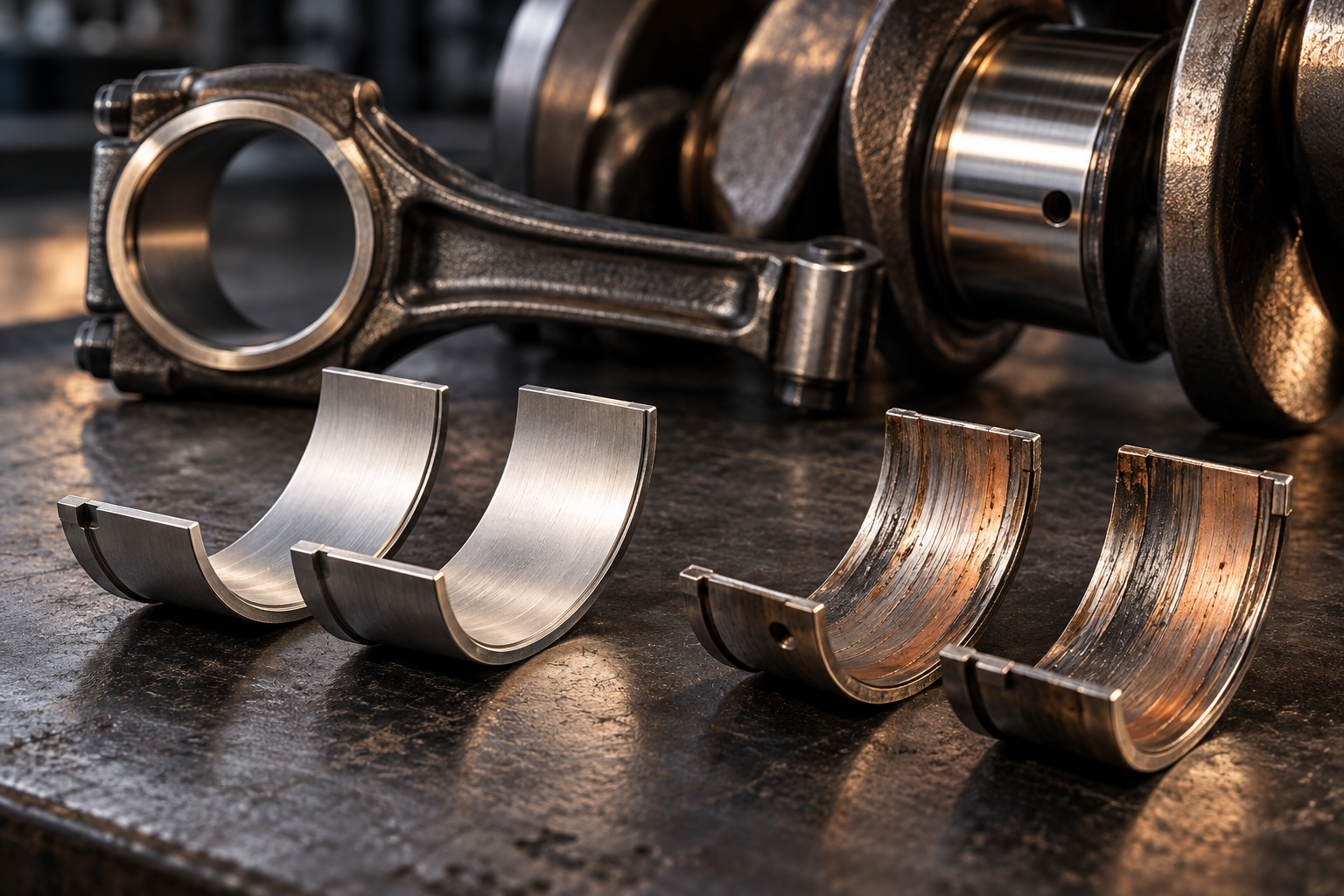
Rod bearings are small engine components with a big responsibility. When they lose lubrication or become damaged, the result can range from excessive wear to a spun bearing and major engine damage. Certain BMW M engines have well-documented rod bearing concerns, but bearing failure can also happen in engines that are not known for a common rod bearing problem.
What are rod bearings?
A connecting rod links each piston to the crankshaft. At the rod’s larger end, two curved bearing shells fit around the crankshaft journal—the smooth surface the rod rotates around. These are plain bearings, not ball bearings.
The shells provide a precisely fitted bearing surface. During normal running, a thin film of oil separates the crankshaft journal from the bearing. The crankshaft’s rotation creates an oil wedge that supports the load. Maintaining that film depends on a continuous supply of suitable, clean oil and correctly matched components.
Rod bearings are different from main bearings, which support the crankshaft in the engine block. Both depend on proper lubrication.
Why do rod bearings wear or fail?
Healthy bearings should operate largely without metal-to-metal contact once the engine is running. Accelerated wear develops when lubrication, loading or component geometry falls outside what the assembly can tolerate. Possible contributors include:
- Insufficient oil supply: Low oil level, an oil pump problem or restricted oil passages can deprive bearings of lubrication.
- Contaminated or degraded oil: Debris can score bearing surfaces; fuel or coolant contamination can weaken the oil’s ability to carry load.
- Incorrect clearance or assembly: The gap between the bearing and journal must suit the application. Distorted components, unsuitable parts or incorrect installation can cause localized wear.
- Excessive loading: Detonation, increased engine output and demanding operation can overload the bearing material.
- Heat and material fatigue: Repeated stress and inadequate lubrication can damage the bearing’s working layers.
Oil viscosity, bearing clearance, oil flow and operating temperature work together. Thicker oil is not automatically better, and changing viscosity is not a repair for worn bearings. Use the oil specification appropriate for the exact engine and discuss any changes with a specialist.
A failed bearing does not automatically prove the owner neglected maintenance. Manufacturing, lubrication, assembly and operating factors must be evaluated before assigning a cause.
What happens when a rod bearing spins?
The bearing shells are supposed to stay fixed in the connecting rod while the crankshaft rotates inside them. Their fitted clamping pressure, called bearing crush, keeps them in place. Locating tabs primarily assist installation; they are not what holds the bearing against running forces.
A spun bearing occurs when a shell moves or rotates inside its housing. Loss of lubrication can let the bearing seize against the crankshaft, with friction overcoming its retention. Incorrect crush or housing dimensions can also contribute.
The resulting damage can affect the crankshaft journal and connecting rod, disrupt lubrication and release metal debris. Severe failure can progress to seizure or broken internal components. Continued running can greatly increase the damage.
Installing new shells alone may not be enough. The crankshaft and rod must be inspected and measured, the lubrication system evaluated, and contamination addressed. Depending on the findings, repair may require machining, replacement components, an engine rebuild or a replacement engine.
Which BMW engines are known for rod bearing concerns?
The best-known examples include the following. This is a list of recognized concerns, not a prediction that every engine will fail.
S54 inline-six — E46 M3 and other S54 applications
BMW issued a connecting rod bearing service action for certain E46 M3 vehicles produced from February 12, 2001 through May 22, 2003. Its bulletin identified bearings that did not meet manufacturing standards and could overheat and fail prematurely during sustained higher-speed operation.
The S54 also powers certain Z3 M and Z4 M models, but that specific E46 campaign should not be assumed to cover every S54 vehicle. Verify the individual vehicle’s production information and service history. Completing an earlier campaign does not establish the condition of its bearings today.
S65 V8 — E90, E92 and E93 M3
The S65 is widely associated with premature rod bearing wear. Engine builders have documented clearance variations and investigated the interaction of clearance, lubrication and bearing loading. It is too simplistic to attribute every failure to one cause or promise that one replacement bearing eliminates all future risk.
S85 V10 — E60/E61 M5 and E63/E64 M6
The S85 also has a recognized history of premature rod bearing wear. As with the S65, maintenance records, previous bearing work, engine condition and driving use matter when discussing preventive service.
Can other BMW engines suffer rod bearing failure?
Yes. An engine does not need a reputation for rod bearing failure to experience one. The general failure mechanisms—such as oil starvation, contamination, overload or incorrect assembly—can affect other BMW engines too.
That does not mean every BMW needs preventive rod bearing replacement. An isolated failure is not evidence of an engine-wide defect, and an engine’s good reputation is not proof that an individual car’s bearings are healthy. Recommendations should follow the vehicle’s history and actual findings.
Warning signs and when to stop driving
A new deep knocking noise, an oil-pressure warning or metal debris in the oil or filter warrants prompt attention. These findings can have more than one cause and require diagnosis. Bearing wear may also develop without an obvious warning.
If you hear a serious new engine knock or receive a low-oil-pressure warning, pull over safely, shut the engine off and arrange a tow. Do not repeatedly restart it to demonstrate the noise or drive it to the shop.
Oil analysis can provide useful clues, but a normal report cannot certify healthy bearings. Bearing materials differ, and a sample does not directly measure clearance or inspect the shells.
Replacing a leaking oil pan gasket? Consider rod bearings at the same time.
At Fox Motors, we recommend replacing the rod bearings as preventive maintenance whenever we are replacing a leaking oil pan gasket. The oil pan must be removed to access the rod bearings, so an oil pan gasket repair is a practical opportunity to discuss and perform this additional service.
Combining the jobs takes advantage of the access already needed for the gasket repair and can reduce overlapping labor compared with returning later for a separate rod bearing replacement. Bearing replacement still requires additional parts and labor; it is not included automatically with an oil pan gasket repair.
The goal is to replace the bearings before wear progresses to a failure that can damage the crankshaft, connecting rod or engine. We explain the additional work and cost before proceeding, taking the engine, mileage, service history and any previous bearing replacement into account.
Should you replace rod bearings preventively?
For an S54, S65 or S85, preventive replacement deserves a conversation based on mileage, documented bearing service, intended use and your ownership plans. There is no single mileage that guarantees safety or predicts failure for every car. Preventive service and repair after a spun bearing are different jobs.
Keep up with appropriate oil and filter service, monitor oil level, address lubrication concerns promptly and allow the engine oil to warm before heavy load or high RPM. These habits reduce avoidable stress; they do not guarantee that bearing failure cannot occur.
BMW rod bearing advice in Tampa Bay
At Fox Motors Bimmer Specialists, we advise, not upsell. Whether you own an M car with a recognized bearing concern or another BMW with an unexplained noise, the next step should be based on evidence.
Contact Fox Motors to discuss your BMW’s engine, mileage, service history and symptoms. We can help you understand the appropriate next step and whether diagnostic inspection or a preventive bearing service discussion makes sense for your vehicle.
Technical references
- MAHLE: Bearing lubrication and failure prevention
- MAHLE: Oil clearance, viscosity and bearing retention
- King Engine Bearings: Failure analysis guide
- King: Spun bearing causes and repair considerations
- BMW SIB 11 04 04: S54 bearing service action (archived copy)
- Lang Racing: S65/S85 bearing observations
- BE Bearings: Bearing materials and oil analysis limitations